Thursday, May 17, 2012

Birds' Paradise - Trip to Australia, Part III

Crimson Rosella
Long-billed Corella


Red-tailed Black Cockatoo
Australian White Ibis in the park

Scene from hotel window
On our first morning at Maquarie University we were woken up at early dawn by the shrill cry of birds outside our hotel window and upon looking out of it we were startled to see flocks of large white birds everywhere, on the grass, asphalt, and roof tops. These turned out to be the Long-billed Corella, a cockatoo native to Australia--a large white bird with a red stripe around the eyes and on the chest.  I include the picture of the long-billed Corella above taken from Wikipedia for it shows a good close-up of the birds; the picture to the right gives a sense of what I saw out of our hotel window.   

Birds in Australia make a bold presence in both urban and suburban environments in terms of their brilliant colors, loud cries, and sheer number, more so than they do in America. We certainly felt their presence very vividly in our brief stay there.  The dense vegetation and large bird population give the country an exotic, tropical flavor;  I can easily imagine scenes from Hitchcock's movie, The Birds, taking place here.  Here is a video I took with my phone while strolling back to our hotel from the beach in Port Douglas. 

"The Birds"

We attended a free-flight bird show during our visit to the Taronga Zoo, located just across the bay from the Sydney Harbour, but hidden from view by the thick green foliage on the hill, accessed via a short ferry ride.  Kirk caught a picture of a flock of Red-tailed Black Cockatoos in flight at the zoo-keeper's call.  The Australian White Ibises are a common sight in the city parks, scavenging for food on the pavements and in the trash bins; we were told by the volunteers at the zoo that they are viewed as pests.  

While we were at Canberra, I went on a walk at the Australian National Botanic Gardens with a volunteer guide.  He pointed out to me many Australian native plants as well as birds which happened to be around.  We caught sight of a gorgeous Crimson Rosella; I was able to point one out (see picture above) to Kirk while out walking on the campus of the Australia National University on our last evening in Canberra.

Bottle-tree
The wood of the Bottle-tree contains a jelly which is supposed to be nuitritious and the sap from the trunk is drinkable.  In addition, I learned that the seeds, young roots and shoots were cooked and eaten in Queensland in the past. Wollemia nobilis, my guide told me, belongs to a 2-million- year-old species of coniferous trees but was only discovered relatively recently (1994).   

Koalas in the zoo
Australian Water Dragon
We saw an Australian Water Dragon sunning himself on a rock in Manly, a beach town on the northeastern coast of New South Wales, a 30-minute ferry ride from the Circular Quay at Sydney.  And, speaking of the flora and fauna in Australia, how anyone can omit to mention koala bears and kangaroos!  We saw several of both in Taronga Zoo, among many other animals and plants native to Australia.  The kangaroos we saw in the zoo, lounging or standing still in the shade, were not particularly lively.  Luckily, we were told by Frank Jackson at ANU that wild kangaroos can be seen at dusk in the Botanic Gardens, which is conveniently located on one side of the ANU campus, at the foot of Black Mountain.  So the evening before we left Canberra, Kirk and I hastened to the Gardens a few minutes before closing time hoping to catch sight of some wild kangaroos. We were told by the gardener we met there that we could definitely see some of them on the "Eucalypt Lawn" near one of the trails, but that we had to hurry as the gate would be shut in 15 minutes.  We grabbed a map and ran like mad toward the area pointed out to us and, lo and behold, a kangaroo, hopping mindlessly along, stopped dead in front of us, with a look of surprise and uncertainty.  Here is a video of our roo-sighting at close range -

Roo-sighting


Wednesday, May 16, 2012

The Great Melting Pot - Trip to Australia, Part I

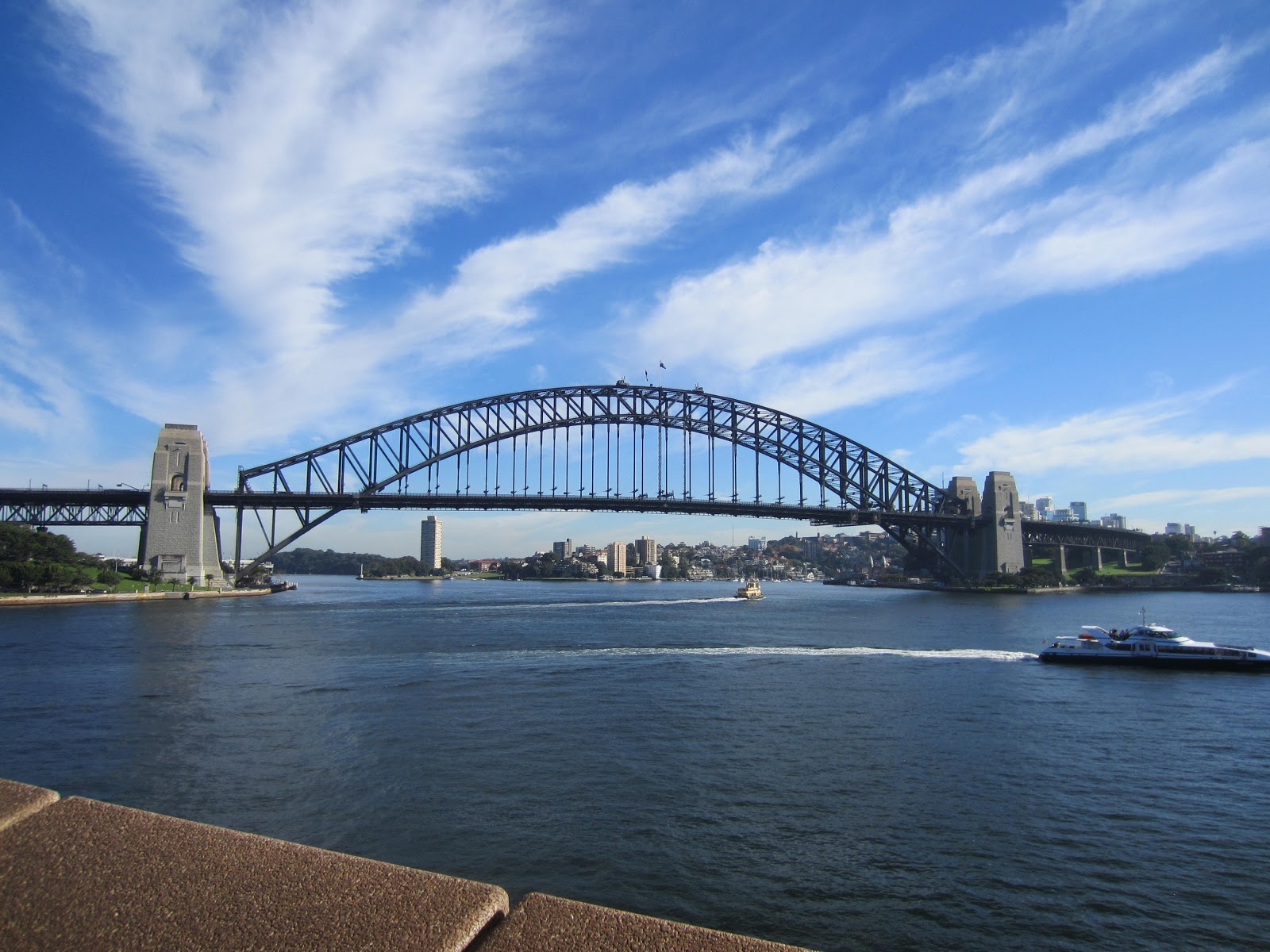
Sydney Harbour Bridge
Crowded night scene at SOH
We spent the first week of our trip to Australia in Sydney and one of its suburbs, Macquarie Park, where the Macquarie University is located, about 30 minutes northwest of Sydney by train.  Aside from the two days when Kirk was sequestered at a workshop, we did most of the must-sees and must-dos for the itinerant tourists in Sydney.  Without losing a minute, as soon as we deposited our luggage at the hotel in Sydney after about a 24-hour journey, we went out for a long walk heading toward the popular Circular Quay and Sydney Harbour.


Dining at the Studio Cafe
Other than the familiar sights and sounds of any crowded cosmopolitan city, the overwhelming impression we got of Sydney was the size of its Asian population and how well integrated they are in the society.  The metropolitan area of Sydney seems to me like a huge Chinatown, or what I imagine the city-state of Singapore would be like.  In addition to Chinese, who immigrated en masse to Australia during the gold rush era in the 1850s, the population of Australia is made up of immigrants from all over the world beginning in the 17th Century.  According to published demographics of Australia, about 24% of its total population was born outside of Australia, of which those from the UK make up the largest contingent, followed by New Zealand, Italy, and China.  Over 8% of its population is of Asian descent (consisting predominantly of Chinese, Vietnamese, Filipino, and Indian), while the Australian Aboriginal comprises only 2.3%.  To an outsider's eye, all these immigrants, of various colors and stripes, seem to be co-existing well together and to have assimilated seamlessly into Australian society, occupying diverse social roles and stations in life.  In any case, the result is a cornucopia of languages on the streets and of cuisines served in restaurants.  But it is not always what you expect.  I had a very odd but hilarious experience once in a subway car listening to a conversation among some Asian teenagers (ethnic Chinese and Indians) complaining about their teachers and classmates in the purest and thickest of Aussie accents.  For me the incongruity of oriental faces and Aussie accents was both comic and delightful.     

Another aspect of Australian culture that we found striking was their laid-back attitude.  A common response to queries in our dealings with Australians was "No worries [mate]," as the Qantas clerk said to us when we asked about having less than an hour to transfer from the domestic terminal to the international terminal by bus to catch a flight at the Sydney airport.  Another example is their rather relaxed attitude regarding airport security -- nobody checks your IDs or boarding passes when going through security, or when getting on the plane.  I wonder whether this laid-back attitude is an offshoot of their colonial past, when Australia in its great distance and isolation, represented to early settlers a land of milk, honey and sunshine, with the sure prospect of charting a new life.  Only the desperate or the unrepentant optimist would make such an arduous sea journey -- Mr. Micawber and Family, being both, did swimmingly well in this land of new promise.     


Underwater Adventure - Trip to Australia, Part II


Sunset at Port Douglas
To me, and Kirk too, I think, the most memorable part of our trip to Australia was the time we spent in Port Douglas, and in exploring the Great Barrier Reef in particular.  Port Douglas, a small seaside town with a population of about 1500, not counting tourists, is located on a peninsula off the northeastern coast of Queensland.  Amid swaying palms and a lively tourist crowd, with a busy marina on one end and a four-mile stretch of sandy beach on the other, Port Douglas reminds me of the towns in Florida Keys.  


Happy as a clam
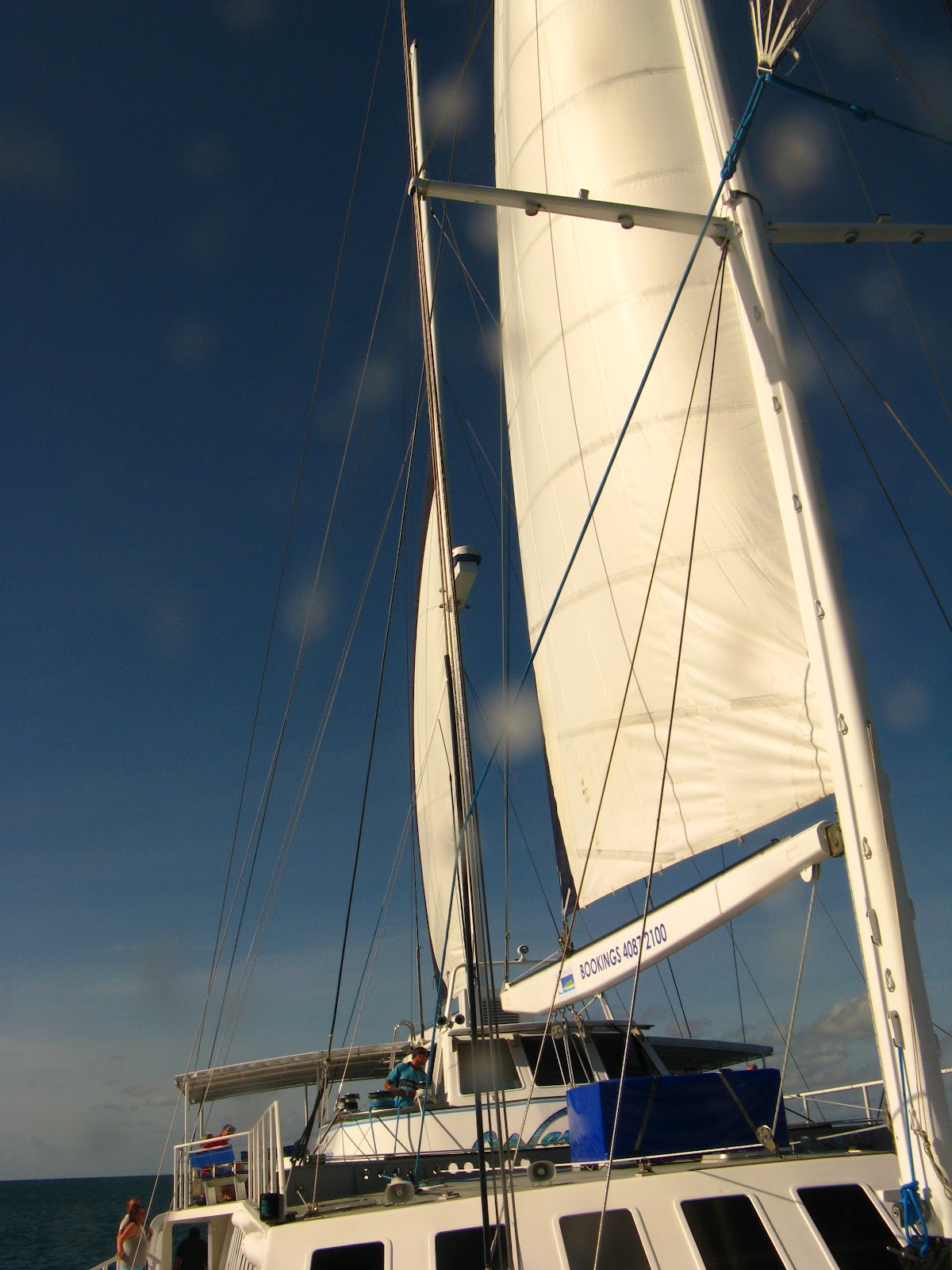
We spent two whole days exploring the Outer Barrier Reef and the Low Isles aboard the Quicksilver catamaran and sail boat respectively.  True to the Aussie "no worries" attitude, we were taken down 10 meters (about 33 feet) deep, in full scuba diving gear, by a couple of diving instructors with hardly any preliminaries.  Having done one scuba-diving lesson in an indoor pool beforehand turned out to be crucial; two people who signed up for the dive but had not had any diving experience backed out at the last moment after taking a dip into the abyss.  My brief 30-minute underwater adventure seemed like a dream to me at the time; I was so distracted by all the creatures I saw down there that I forgot to feel any fear or anxiety.  My snorkeling experience in open water, however, was less successful; still not confident in my swimming ability, I was worried that I might be carried too far away by the current and wouldn't be able to make it back to the beach.  Kirk made the most of the time allotted to us on the open water by taking two scuba dives and numerous snorkeling trips and took some amazing underwater pictures.   


Quicksilver catamaran
piercing the waves
QS Wavedancer
full speed ahead 


Our underwater adventure was captured in the video below:


05.25.2012
P.S.: I forgot to include a picture of some seafood dishes we had at a restaurant in Port Douglas called 2Fish.  There were so many restaurants there, all seemed to be crowded at night, that our picking this one out among the rest was a stroke of luck.  The food was quite good and well-presented that we ate there two nights in a row.  At the top of the picture below is a crusted "baby" barramundi.   

Baby Barramundi & Sashimi
      

Thursday, April 5, 2012

A house to grow old in...

I have been working on a design on and off since last November; it was to be a smallish house with a self-contained walled garden, intended to be friendly to people getting older-- i.e., it's relatively barrier-free, with easy connections to the ground, and, as Wright said, "sans attic, sans basement."  As usual, I dipped into Christopher Alexander's Pattern Language and Frank Lloyd Wright's Usonian Houses for inspiration, and after spending a couple of weeks on the initial design, I gradually built it, metaphorically speaking, from the ground up and fit it out as a computer-generated model.  Here are some renderings of the house --


Floor Plan


Site Plan
Note the massive array of solar panels
West Elevation


North Elevation


East Elevation


South Elevations


Interior Views
Entry Porch looking toward courtyard garden
Living Room looking toward garden
Living Room - Piano Alcove


Dining Room looking toward Kitchen
Kitchen
Office/Guest Bedroom
Office - Desk Alcove
Master Bedroom
Master Bedroom - Sitting Alcove
Guest Bath
Master Bath (dappled light effect unintended)

Walk-through videos, Updated 4.7.12 
(Please ignore the funny, cardboard-like vegetation.)


Exterior


Interior


Wednesday, April 4, 2012

Crimson Azaleas

Crimson Azaleas
Welcome you to the house
& adorn the table


While white and pale pink flowering dogwoods have graced most of the yards in our neighborhood, ours is distinguished from the rest by some striking crimson azalea shrubs planted strategically in the front yard--leading one from the entry paths to the front door steps.  We were surprised last spring to see the many different plants which bloomed in our yard after the harsh winter but we don't recall having seen these showy crimson azaleas.  At first we weren't sure what these flowers were; they don't look much like the large azaleas in various colors which we were accustomed to see in Florida and only after looking at them at close range did we see the resemblance.  There are still quite a few shrubs and trees that have not filled out yet and we expect to see many more late bloomers in the coming days and weeks.  What a                                                delightful season this spring promises to be!