Sunday, July 15, 2012

Domus Revisited

View from above
I got the idea of my new house design while listening to a podcast, Lifestyles of the Rich and Famous: Houses and Villas at Pompeii, also available as a video, which is part of a course on Roman Architecture by Diana Kleiner from Yale University on iTune U.  In it she describes in detail the ruins of houses and villas in Pompeii which survived the catastrophic eruption of Mount Vesuvius in 79 AD.  I was attracted to the simplicity of the ideal Roman House Plan (Domus Italica) which she attributed to the writing of a Roman architect, Vitruvius, who flourished in the 1st century BC.  I thought that the typical Domus house plan, which is essentially a house with an open courtyard (atrium), could easily be transplanted to an urban or suburban environment in today's world in a suitable climate.  Courtyard style houses were by no means invented by the Romans but can be found in many ancient cultures, including Islamic, Hindu, and Chinese civilizations. 

I have always been partial to this particular dwelling type, as you can tell from the several houses I designed and published on my blog, ever since my mother took me to visit my aunt's house in the countryside of southern Taiwan when I was little.  The house left a strong impression on me to this day.  It was a three-sided courtyard house consisting of a series of rooms wrapped around a large courtyard with openings connecting them to one another on the courtyard side of the rooms.  It housed three generations of two families, one on each wing, with the connecting side shared between them; the children and women of the two families, who were related, shared play and work in the open courtyard.  It seemed to me to be a very efficient arrangement of dwelling space, specially suited for the agricultural society where it existed. 

My design closely follows the arrangement of room-functions in the simple Domus Italica plan with a tripartite division of space facing the street -- two large public spaces, which were shop fronts in ancient Roman time, now a garage and an office or studio, flanking a narrow entryway in the middle.  After passing through the vestibule, one enters the main courtyard of the house, open to the sky, with a fountain in the middle, surrounded by a colonnaded porch.  A series of bedrooms and baths line the east side of the courtyard, with the utility room, a half bath, and the kitchen on the west.  The living/dinning room and the master bedroom are located on the south end of the courtyard which look into the garden in the back through another colonnaded porch.  The design as it is, a compact 2,340 S.F. house for two persons, can be implemented on a narrow urban lot -- a private oasis hidden behind tall walls.  It can easily be enlarged, if one so desires, by stretching it in the north-south or east-west direction, or both.  

Here are some renderings of the computer model I made of the design:   

North Elevation
South Elevation
East Elevation
West Elevation
Transverse Section looking North
Transverse Section looking South
Longitudinal Section looking East
Longitudinal Section looking West
Courtyard looking South
Courtyard looking East

Living-Dining Room
Kitchen

As usual, I made a walk-through animation of the exterior and interior of the house.  I still haven't perfected the techniques of making smooth animations, but you can at least get a sense of what it's like walking around the house inside and out.

Exterior Walk-through

Interior Walk-through

Wednesday, July 11, 2012

The Clever Calvin

We have quasi-adopted a cat named Calvin who lives two-door down from us on our street. The reason we know these facts about him is because he wears a collar with a tag and tiny bell on his neck.  He is very affectionate, a sucker for belly rubs, and very persistent in seeking attention.  He walks around the neighborhood, visits all the houses, and is, for all we know, greeted affectionately by all.  He often pays us a morning call while we're having breakfast in the Sunroom and then comes back for an evening visit at supper time, with a little tinkling of the bell announcing his arrival.  It isn't because he wants to be fed that he comes around at those hours but because he can usually find us then.  I've come to miss hearing his tinkering bell if he doesn't show up during meal time. 

Calvin started visiting us several months ago; whenever we were out in the yard he would appear, seemingly from nowhere.  As he seemed friendly, we would pat him and play with him a bit.  I was often startled by his tail brushing against my legs when I was doing something in the yard; I even had the uncomfortable feeling of being stalked.  Once we got to know him better, whenever he saw us outside he would follow us closely whichever direction we moved with the intention, which soon became clear, of nudging his way inside our house.  One of his signature maneuvers toward that goal was to dart, of a sudden, in front of us and plump himself down at our feet at every opportunity, intercepting our walk, and eventually, landing his body right at our doorstep, preventing us from opening the door, or more precisely, getting into the house without him.  We were resolute about not letting him into the house at first; so to get rid of him, Kirk and I had to work as a tag team, with one of us occupying his attention while the other sneaking into the house from another door.  Another tactic he used was to sit in front of the Sunroom door and meow pitifully.  

I don't remember when we tacitly decided to let him in, to the Sunroom only, mind you, not inside the house.  Before long, he was on our laps or sitting next to us on the chair and being patted and rubbed to his heart's content.  

One morning last week, I noticed traces of blood on his face when I picked him up, and upon closer examination, I found that his nose was badly cut up.  It was so pitiful that while he looked at me with his doleful eyes, I couldn't bear to look him in the face.  I got the phone number of his owner from his tag and called.  His owner happened to be out of town but luckily his stepson, who was house-sitting, was able to pick him up and take him to the vet.  His stepson told Kirk that Calvin was fine when he let him out that morning.  We don't know what kind of scrape he got himself into to get the tip of his nose cut in half!  We were very relieved to see Calvin again a few days later; he was back to his usual playful self but I'm afraid his face is permanently disfigured.  I wonder if I would be able to let my cat out, if I had one, risking all kinds of danger.  But if you don't, what miserable life it is for them to be always cooped up in the house.  Unlike the domestic canine, strict domesticity and security don't seem to sit well with these independent-minded, freedom-loving creatures, or so I imagine.  As philosophers say in this case, it's not possible for us to know what it is like to be a bat (or, cat). 


Clever Calvin


No-nose Calvin, poor baby

Friday, June 8, 2012

Honest to John's Philosophy of Mind

I discovered some time ago an immense treasure trove of knowledge available on-line for free--the iTune [Virtual] University. Like Google's Gutenberg Project which makes available without charge a huge collection of copyright-expired books in digital format, iTune U provides podcasts or recordings of actual classroom instructions from various colleges and universities of various subjects which anybody (with Internet service) can subscribe to and listen to remotely (both in space and time) like a fly on the wall. What a democratizing service this can provide, in terms of disseminating knowledge and raising the general standard of education, if only more people take advantage of it! In addition, it also serves to preserve an oral record, as it happens, of our intellectual history for future generations.

While browsing what's being offered at iTune U, I stumbled on some philosophy courses given by John Searle, I almost want to say, Sir John Searle, at UC Berkeley-- the same guy, in case you don't know, who taught there when Kirk was a graduate student almost thirty years ago. (Incidentally, don't believe everything written on the Wikipedia about Searle, especially on his philosophical views, as, according to him, a lot of it is incorrect.)  He is a famous professor of philosophy for many reasons, not the least of which is his teaching persona--brassy, John Wayne style in his self-assuredness, and very entertaining, almost vaudeville-like, I imagine, as he has been doing these routines for upward 50+ years.

I started listening to his spring 2010 lectures on Philosophy of Mind (132) on and off for some time now and I can't tell you how much I have enjoyed listening to them.  For my non-philosopher readers, if you ever wonder what they teach in undergraduate philosophy courses, you can't find a better specimen than Searle's.  Here is a recording of one of the same lectures he gave in 2011 in its entirety -


But I have to admit that I do not listen to these lectures with a hundred percent attention. Instead, I listen to them when I want to keep my mind from dwelling on what I may be doing at the time--mindless activities such as cleaning the house, or running on the treadmill or on the road. The grumpy mood that never fails to surge up in me when doing chores seems to vanish completely while my mind is trying its utmost to follow and understand what is being said. Time seems to elapse imperceptibly and more pleasantly in the interval. Last Sunday I managed to listen to three of his one-hour long lectures while doing my bi-weekly house cleaning.

I do not mean, of course, that I was able to keep up with all that was said in the class, but I do get the gist of each lecture and have some idea about the main issues in the Philosophy of Mind, the key figures in the said philosophical tradition, and, most importantly, how they are all wrong-headed, at least, according to John.

What follows are two videos on YouTube of Searle being interviewed, one considerably younger than the other; there are quite a few videos available on YouTube should you want to learn more about him -


Sunday, May 20, 2012

Where are my 'tatatoes'?

I did my first piano recital, that is, in public, today along with the other students of my teacher.  I played Prelude 1 in C by Bach from Book I of the Well-Tempered Clavier.  I ran into several rough spots but, overall, did not embarrass myself (too) badly in front of all these grade school kids and their families.  On the surface the piece may not look so difficult to play, but to play it well is not a simple matter.  It's like trying to achieve the precision quality of Glenn Gould and the hypnotic quality of Philip Glass, while at the same time to sound as serene as possible, in short, it is a very tall, or next to an impossible order.  My teacher, to help me get into an even rhythm, used to count aloud while I played, "one tatato, two tatato, three tatato, four tatato, one ..."  They got so drummed into my head that lately I dreamed about them at night.  Here is the video of my recital; for the professional pianists out there, my advice is to skip this to save the suffering of your ears.  


Architecture Downunder, Trip to Australia, Part IV

Contrary to my custom, I have saved the post on architecture on this trip for the last, partly because I knew very little about the history and major figures of Australian architecture before our trip and I wanted to do some more research on what we saw.  The only Australian architect that I learned about in architectural school is Glenn Murcutt, who won the Pritzker Prize in 2002.  I was not able to see any of his buildings on this trip however, for most of his works are residential and are for the most part not open to public. It was a bit hard tracking down information about Australian architecture, that is, architecture by Australian architects.  There's not a lot known about it, it seems, outside of Australia.  Some of the most famous works of architecture in Australia are not, strictly speaking, Australian.  The world renowned Sydney Opera House was designed by a Dane, Jorn Utzon; while its famous National Capital, Canbarra, a planned city from scratch, tabula rasa style, was envisioned by an American architect, Walter B. Griffin.  So to begin.

Souvenir from Sydney
First: the phony souvenir picture of us with the Sydney Opera House in its grandeur in the background!  We failed to resist buying into the whole commercial scheme when a "Memories from Sydney Opera House" package was offered to us after our tour at that iconic building.  At least it gives you a good view of the front of the halls at night.  In any case, it was a real treat to have seen the building and have attended a concert, Mozart's Requiem, in its magnificent Concert Hall.  It is a great pity that we will never know what Jorn Utzon's vision was like for the inside of the building, for he abruptly left the project and the country, after a prolonged and painful series of irreconcilable conflicts with the Australian Authorities regarding its construction time and budget, after only the main structures, the plinth and shells of the building, had been completed.  Here is a retrospective video about Utzon and the Opera House, as well as a link to the Guardian's website about the building - 


The best way to see the whole of the Opera House is to go on board one of the ferries either to Manly or Taronga Zoo.  When viewed from the water side, it looked to me like a line of medieval knights' heads in armour with their visors drawn down.  

It is almost impossible to take a bad picture of the Sydney Opera House.  We took so many pictures of it that you would think there would be some bad ones among them.  But its shape and profile, from every angle, seems to be just perfect. 


Knights in armour
Iconic profile
Silhouetted against the night sky
Mythical creature taking flight
Harbour Bridge all lighted up
Ferry docking at Circular Quay
We went on a walking tour, sponsored by the Australian Architecture Association, of the Central Business District (CBD) in Sydney and saw some historical buildings and skyscrapers designed by eminent Australian architects from the mid 20th Century which we wouldn't have known otherwise.  Here are some of the buildings we saw on the tour -


MLC Center
      
      Australia Square Tower
Capital Center

All three skyscrapers above were by Harry Seidler (1923-2006).  I can't say that I'm enamored of them.  Then, there were some more recent skyscrapers which have sprung up around the hottest commercial property in the northeast quadrant of Sydney's CBD area overlooking the harbour.  I was not able to get a good picture of Aurora Place by Renzo Piano and substituted one from the web -


Governor Philip Tower
  
1 Bligh Office Tower
Aurora Place

I also ventured out of the CBD area of Sydney and went over to the west side to check out the new Law School building at Sydney University.  The students there seemed to have the best of all possible worlds!  The library of the Law School is situated under the plaza with the cylindrical-shaped-but-sliced-on-top-at-an-angle, "light tower" illuminating the reading room below. 

Lounging in style
New Law Building, Sydney U.
Now, to expose my ignorance of Australia's vernacular architecture - on the way to Sydney University, I noticed some striking, so it seemed to me, narrow buildings lining tight up against one another on both sides of the street.  Each had a narrow, perhaps no more than 4 to 5 feet deep, strip of fenced front yard or porch, with a balcony on the second floor above, the space of both, in most cases, was taken up with tired old couches or by trash bins. The last made them resemble poorly maintained apartments like any student ghetto, but on a second look, there was something about them that attracted my attention; each individual building looked quirky and slightly different from each another.  

Student Ghetto
"gentrified"
I thought I had discovered something very special and mentioned it to somebody whom I met at a social gathering.  "Oh, sure," he said, "they are called Terraced Houses, and they are everywhere!"  I must not have been paying attention, for my impression of Sydney was all skyscrapers and dirty streets in popular tourist hangouts.  These terraced houses, I later learned, were the Australian version of Victorian or Edwardian row houses!

Hexagons and circles
Griffin's vision
Fast forward: we spent the last few days of our trip at Canberra, the National Capital of Australia, a little self-governing inland territory, called ACT, Australian Capital Territory, located roughly midway between Sydney and Melbourne.  Like Washington D.C., it is chock full of federal government buildings, foreign embassies, national monuments, museums, gardens, and universities.  While researching about the place before the trip, I noticed the rather unusual grids of the city--instead of the more common rectangles, there are hexagons and circles here.  I have read about examples of large scale urban planning and transformation in the history of human civilization, Haussmann's Paris modernization plan in the Napoleon era comes to mind, but this is something else--some architects from Chicago, Walter Griffin and his wife, Marion Mahony, actually dreamed it up, guided by their Utopian visions and democratic ideals, from empty fields of grazing sheep, when they participated in and won an international competition sponsored by the Australian government in 1913 to design the Capital City.  However, facing many of the same bureaucratic and political obstacles and setbacks as Utzon did for the Sydney Opera House, the Griffins were forced to resign from the project after a few years.  In consequence, their vision for the capital city was never fully realized.  (There seems to be a pattern here: Announce a competition to secure the most visionary architect, sign him or her up, and then sabotage them by substituting one's own more meager vision after the fact.) 

Axial obsession
A man-made lake
Our experience of Canberra, from being driven around a bit, however, was not completely satisfactory.  For one, it is a city built for automobiles.  Though the major landmarks all cluster around the two central foci, City Center and Capital Hill, which are not far from each other, it is actually not possible to walk from one part to the other for they are separated by an artificial lake, Lake Burley Griffin, with only vehicular accommodation across two bridges but with no provision for pedestrians or rapid public transportation such as raised train service or subway.  Furthermore, the city, though rational and geometric in plan viewed from above, was difficult to navigate, even for those who've lived there for a long time; our host, Frank, had a hard time finding his way around.  Another un-pedestrian-friendly characteristic we noticed there was what we called the disappearing sidewalks.  For no particular reason, sidewalks along the streets would just disappear, leaving one no alternative but to risk one's life (especially since they drive on the wrong (left) side of the road, so that we were always looking in the opposite direction from which the cars were coming) to cross the streets to get somewhere.  

The style of public buildings in Canberra are rather too monumental and masculine for my taste and the city planners down there are excessively obsessed about axiality.  The new Parliament House, for example, which you can see in the left-hand side picture above, sits above and is aligned in an axis with the old Parliament House, and across the lake with the Anzac Parade and the Australian War Memorial.  It is a result of another international design competition, this time won by an American architectural firm and an Italian landscape design firm.  Large portion of the compound is buried underground, carved out of the Capital Hill, the soil of which was then re-deposited over the building when it was completed.  We drove around the complex, and saw quite a few tourist buses parked on the outskirt; though the building is mostly open to public, it is not a place that one can just walk to, unlike the U.S. Capital in Washington D.C. which is within walking distance of the subway.


To close our architectural tour of Canberra, we went to visit the National Museum of Australia.  It is located at the tip of the Acton Peninsula, surrounded by Lake B. Griffin, and a short jaunt from the campus of ANU.  You can faintly see it on the right-hand side picture above, marked by a giant roller-coaster like object.  The complex is composed of a collection of buildings in fantastic shapes, volumes, and colors.  To our dismay, it also suffers from the "disappearing sidewalks" syndrome; there is no direct paved pedestrian route or even foot path to its gigantic portal.  The inside of the building, however, is well laid-out, with tons of objects and information about Australian history and culture. 

Portal to the museum
Light-filled lobby

National Museum of Australia
 like a monster from the lake 
This concludes the report on our trip to Australia!

05.23.2012
P.S.: For those interested in Australian architectural history, don't forget to check out Castlecrag, a suburb north of Sydney, when you're in that part of the world.  I regret not having done so on this trip.  Castlecrag, another legacies of the Griffin's, is a planned suburb, influenced by the Garden City Movement at the turn of the 20th Century.

Thursday, May 17, 2012

Birds' Paradise - Trip to Australia, Part III

Crimson Rosella
Long-billed Corella


Red-tailed Black Cockatoo
Australian White Ibis in the park

Scene from hotel window
On our first morning at Maquarie University we were woken up at early dawn by the shrill cry of birds outside our hotel window and upon looking out of it we were startled to see flocks of large white birds everywhere, on the grass, asphalt, and roof tops. These turned out to be the Long-billed Corella, a cockatoo native to Australia--a large white bird with a red stripe around the eyes and on the chest.  I include the picture of the long-billed Corella above taken from Wikipedia for it shows a good close-up of the birds; the picture to the right gives a sense of what I saw out of our hotel window.   

Birds in Australia make a bold presence in both urban and suburban environments in terms of their brilliant colors, loud cries, and sheer number, more so than they do in America. We certainly felt their presence very vividly in our brief stay there.  The dense vegetation and large bird population give the country an exotic, tropical flavor;  I can easily imagine scenes from Hitchcock's movie, The Birds, taking place here.  Here is a video I took with my phone while strolling back to our hotel from the beach in Port Douglas. 

"The Birds"

We attended a free-flight bird show during our visit to the Taronga Zoo, located just across the bay from the Sydney Harbour, but hidden from view by the thick green foliage on the hill, accessed via a short ferry ride.  Kirk caught a picture of a flock of Red-tailed Black Cockatoos in flight at the zoo-keeper's call.  The Australian White Ibises are a common sight in the city parks, scavenging for food on the pavements and in the trash bins; we were told by the volunteers at the zoo that they are viewed as pests.  

While we were at Canberra, I went on a walk at the Australian National Botanic Gardens with a volunteer guide.  He pointed out to me many Australian native plants as well as birds which happened to be around.  We caught sight of a gorgeous Crimson Rosella; I was able to point one out (see picture above) to Kirk while out walking on the campus of the Australia National University on our last evening in Canberra.

Bottle-tree
The wood of the Bottle-tree contains a jelly which is supposed to be nuitritious and the sap from the trunk is drinkable.  In addition, I learned that the seeds, young roots and shoots were cooked and eaten in Queensland in the past. Wollemia nobilis, my guide told me, belongs to a 2-million- year-old species of coniferous trees but was only discovered relatively recently (1994).   

Koalas in the zoo
Australian Water Dragon
We saw an Australian Water Dragon sunning himself on a rock in Manly, a beach town on the northeastern coast of New South Wales, a 30-minute ferry ride from the Circular Quay at Sydney.  And, speaking of the flora and fauna in Australia, how anyone can omit to mention koala bears and kangaroos!  We saw several of both in Taronga Zoo, among many other animals and plants native to Australia.  The kangaroos we saw in the zoo, lounging or standing still in the shade, were not particularly lively.  Luckily, we were told by Frank Jackson at ANU that wild kangaroos can be seen at dusk in the Botanic Gardens, which is conveniently located on one side of the ANU campus, at the foot of Black Mountain.  So the evening before we left Canberra, Kirk and I hastened to the Gardens a few minutes before closing time hoping to catch sight of some wild kangaroos. We were told by the gardener we met there that we could definitely see some of them on the "Eucalypt Lawn" near one of the trails, but that we had to hurry as the gate would be shut in 15 minutes.  We grabbed a map and ran like mad toward the area pointed out to us and, lo and behold, a kangaroo, hopping mindlessly along, stopped dead in front of us, with a look of surprise and uncertainty.  Here is a video of our roo-sighting at close range -

Roo-sighting


Wednesday, May 16, 2012

The Great Melting Pot - Trip to Australia, Part I

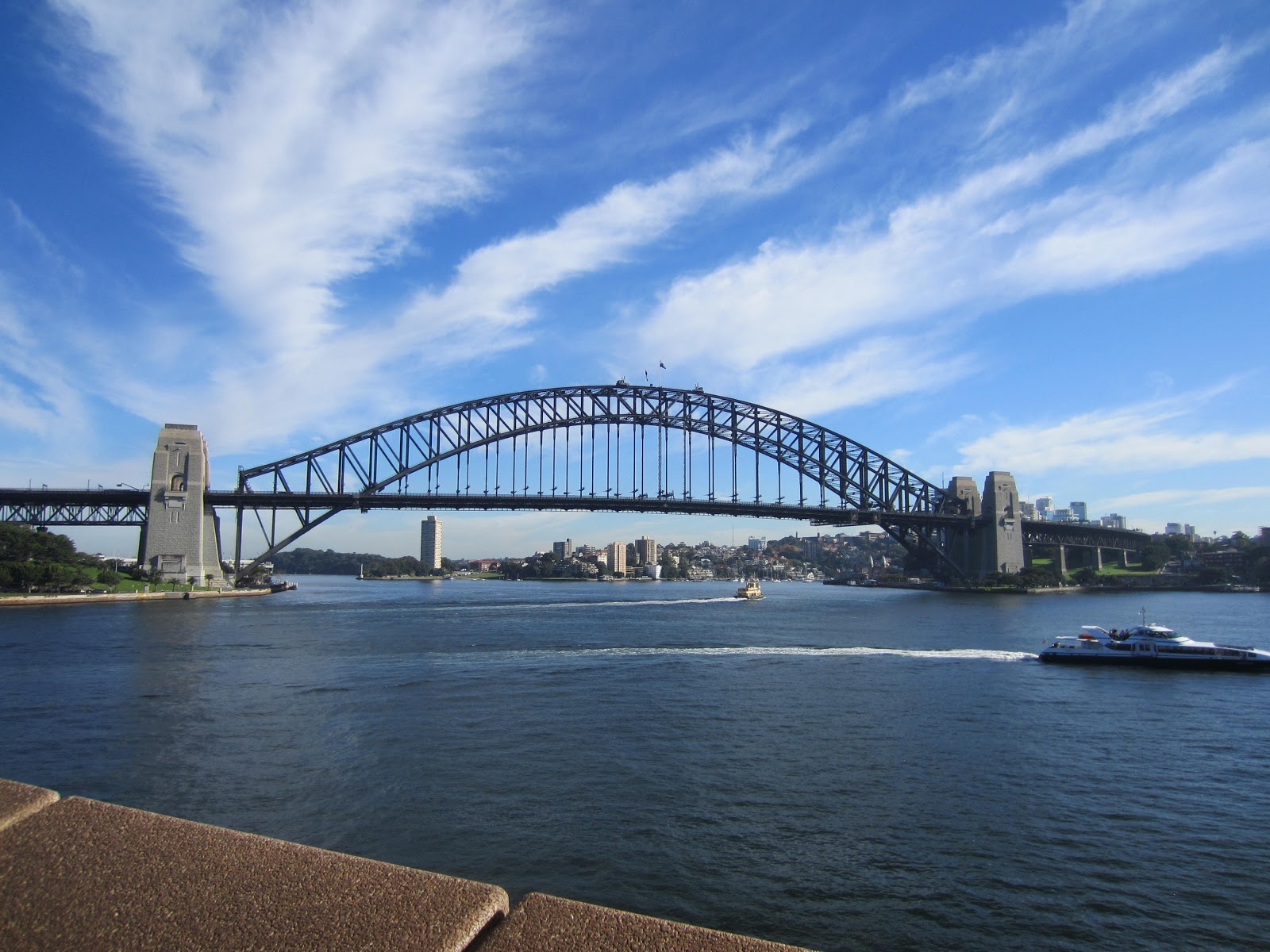
Sydney Harbour Bridge
Crowded night scene at SOH
We spent the first week of our trip to Australia in Sydney and one of its suburbs, Macquarie Park, where the Macquarie University is located, about 30 minutes northwest of Sydney by train.  Aside from the two days when Kirk was sequestered at a workshop, we did most of the must-sees and must-dos for the itinerant tourists in Sydney.  Without losing a minute, as soon as we deposited our luggage at the hotel in Sydney after about a 24-hour journey, we went out for a long walk heading toward the popular Circular Quay and Sydney Harbour.


Dining at the Studio Cafe
Other than the familiar sights and sounds of any crowded cosmopolitan city, the overwhelming impression we got of Sydney was the size of its Asian population and how well integrated they are in the society.  The metropolitan area of Sydney seems to me like a huge Chinatown, or what I imagine the city-state of Singapore would be like.  In addition to Chinese, who immigrated en masse to Australia during the gold rush era in the 1850s, the population of Australia is made up of immigrants from all over the world beginning in the 17th Century.  According to published demographics of Australia, about 24% of its total population was born outside of Australia, of which those from the UK make up the largest contingent, followed by New Zealand, Italy, and China.  Over 8% of its population is of Asian descent (consisting predominantly of Chinese, Vietnamese, Filipino, and Indian), while the Australian Aboriginal comprises only 2.3%.  To an outsider's eye, all these immigrants, of various colors and stripes, seem to be co-existing well together and to have assimilated seamlessly into Australian society, occupying diverse social roles and stations in life.  In any case, the result is a cornucopia of languages on the streets and of cuisines served in restaurants.  But it is not always what you expect.  I had a very odd but hilarious experience once in a subway car listening to a conversation among some Asian teenagers (ethnic Chinese and Indians) complaining about their teachers and classmates in the purest and thickest of Aussie accents.  For me the incongruity of oriental faces and Aussie accents was both comic and delightful.     

Another aspect of Australian culture that we found striking was their laid-back attitude.  A common response to queries in our dealings with Australians was "No worries [mate]," as the Qantas clerk said to us when we asked about having less than an hour to transfer from the domestic terminal to the international terminal by bus to catch a flight at the Sydney airport.  Another example is their rather relaxed attitude regarding airport security -- nobody checks your IDs or boarding passes when going through security, or when getting on the plane.  I wonder whether this laid-back attitude is an offshoot of their colonial past, when Australia in its great distance and isolation, represented to early settlers a land of milk, honey and sunshine, with the sure prospect of charting a new life.  Only the desperate or the unrepentant optimist would make such an arduous sea journey -- Mr. Micawber and Family, being both, did swimmingly well in this land of new promise.