Saturday, January 28, 2012

Aquatic Dreams

IU SRSC Pool
I've recently started learning how to swim.  It may not seem much to you but it's a big deal for me.  Growing up I didn't have the opportunity to learn to swim properly, which was not uncommon for the 99 percenters in our part of the world at that time -- a fact which will become more apparent later on in my narrative.  I used to think that the reason I couldn't swim, a skill which comes naturally for some, was due to my poor eyesight.  I made an initial step towards learning to swim a couple of years before we left Gainesville in having a pair of prescriptive goggles made for me, but still I didn't make it to the pool after that.  In part, I think, it was because I didn't want to make a fool of myself in public.  It seems to be taken for granted in the U.S. that everybody knows how to swim, as if it were a birth right. 

When I saw that adult swimming lessons, for all skill (or non-skill) levels, were being offered at the IU gym, I leaped at the opportunity to learn.  On my first day of class, I observed that all the participants in the Adult Level I group were from the Near or Far East - most were IU undergraduate students from China or Korea, plus a guy from the Middle East, and two older Asian women, including me.  In contrast, the little kids in the Child group were mostly whites, with a couple of Asians, and no blacks.  I couldn't help wondering about the race distribution in both cases.  I would have thought that swimming is no longer so much a luxury sport nowadays in most parts of the world, especially in countries like South Korea or China.  And why the African Americans should not take to swimming, as opposed to basketball, football or track, I can not quite fathom.  Anyways, I personally have a strong incentive to master the basics of swimming this spring -- we will be in Australia for two weeks in early May and we plan to make a detour to Cairns and Port Douglas area for snorkeling trips to the Great Barrier Reef


Monday, January 2, 2012

Year In, Year Out

D.C. at night
I concluded the year 2011 with a visit to the Nation's capital, Washington, D.C.; it was a fitting end to a year spent in living, writing, reading, learning, travelling--in general, taking in, as much as I can, from the sounds and sights of life.  With the exception of travelling, all the other activities and experiences can be obtained free, or with little expense; as I grow older, I've become intensively aware how precious they are and how hungry I am for more. 


the Peacock Room, Freer Gallery
East Bldg., National Gallery of Arts
While Kirk was cooped up in the hotel room interviewing potential candidates for a new faculty position in the Philosophy Department at IU, I packed my four days in D.C. with visits to fifteen museums, galleries, and notable buildings.  I'd only been to D.C. once before, in October 2002, for the Marine Corps Marathon; I didn't get to visit many places then, this time I planned ahead to "do" the museums.  One can spend days just going around the different National museums, gardens, and the zoo of the Smithsonian.  The Smithsonian is, without doubt, the crown jewel of our national treasures; a truly democratic institution, it is open to all, admission free. I was most impressed by the collections at the National Gallery of Arts, and I consider the East Building of the National Gallery of Arts by I. M. Pei, the most dynamic museum space of them all. 


Rothko's on close encounter
(Image from the Phillips Collection)
We also visited some private museums, including the Phillips Collection, the Kreeger Museum, and the Newseum.  Among the modern masterpieces in the Phillips Collection are Renoir's Luncheon of the Boating Parties and four Rothko paintings housed in a small rectangular room limited to 8 people at one time.  I confess this was the first time that I palpably felt the force of Mark Rothko's signature "multiform" paintings of colored rectangles with fuzzy edges. They seem to be breathing, pulsating forms on close encounter; I was mesmerized.  


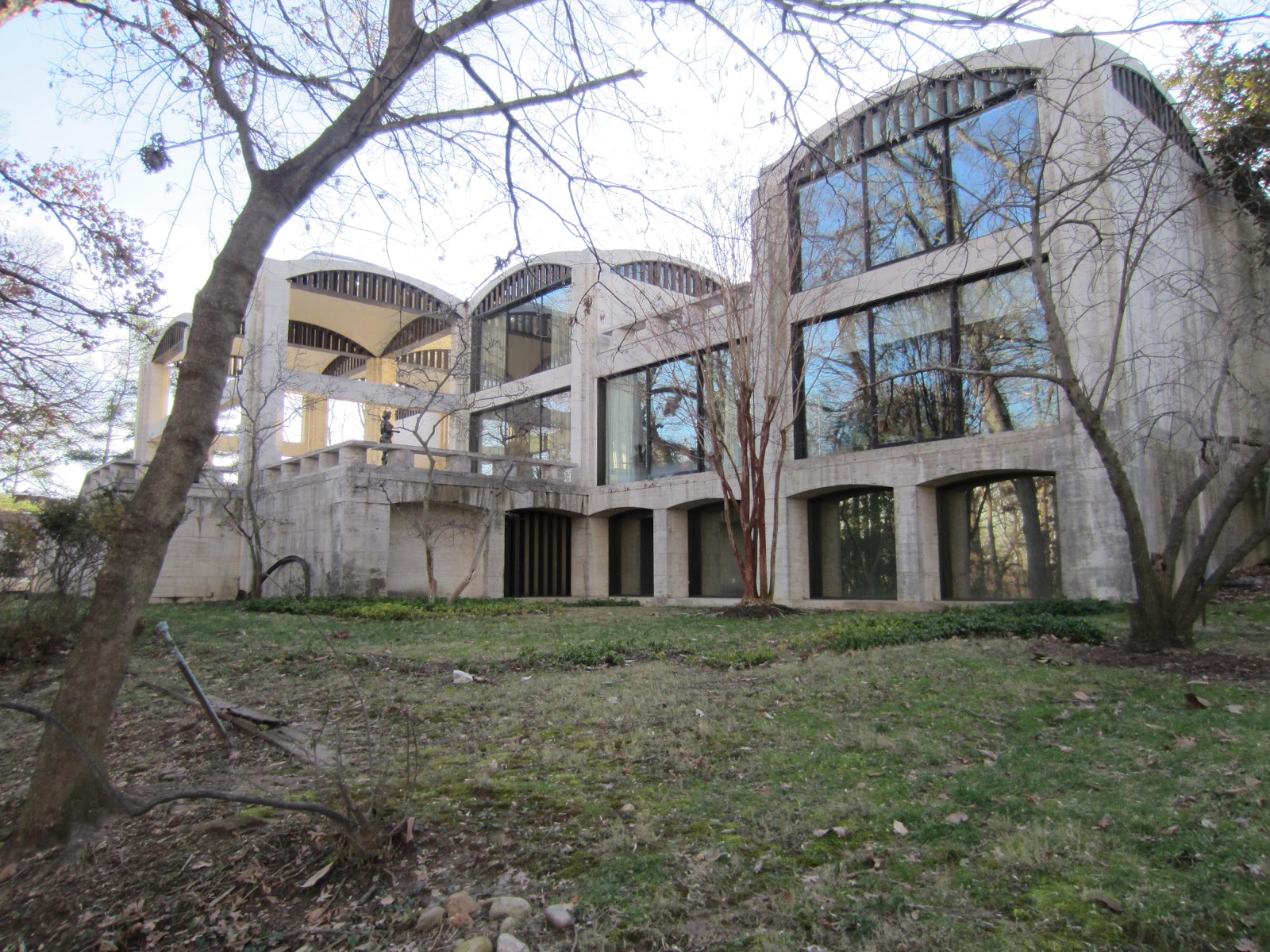
Rear Facade of Kreeger Museum
   
      Front Facade of Kreeger Museum
Art imitates Life
The Kreeger Museum, formerly the residence of the Kreeger family, designed by Philip Johnson, is a less well-known museum, at least for out-of-towners. David Kreeger, a government employee turned lawyer and art patron, who had an out-sized taste for vaulted spaces and an income to match, amassed in his life time a large collection of Impressionist and modern paintings and sculptures.  He commissioned Philip Johnson to design a 24,000 S.F. 'house' to showcase his art collections, entertain in grand style, and live in, presumably, incidentally.  As a museum, this building has found its true calling; as a place to live in, it's unimaginable--the space inside is sterile, cold, and ostentatious.  His private collections of Picasso and Monet, among others, are jaw-dropping, and from the autographed photos displayed in the cloak room, it's apparent that Mr. Kreeger and his wife enjoyed hobnobbing (and name-dropping) with the rich and famous, including almost all the Presidents and First Wives from the second half of the 20th Century onward.  We discovered a very imaginative work of art, in the now dilapidated tennis court, of twisted colored metal made to look like dead branches and vines which crept over the chain-link fence and ugly roots and vegetation strewn all over the parched surface of the tennis court.  


Newseum
Newseum, designed by Polshek Partnership Architects, is one of the few new notable recent additions (it opened in 2008) along the National Mall. This building meets its intended purpose as an interactive museum of news quite successfully, I think.  Its permanent exhibit includes historic newspapers and magazines in the originals dating back to the beginning of printed news (in book form!) from the 1400's.  Like current news media, the numerous exhibition spaces, theaters, and various interactive gadgets inside the building give one a                                                              sense of cacophony and noise. 


The U.S. Institute of Peace, designed by Moshe Safdie, is the newest public building to be erected in D.C. (it opened in early 2011).  Unfortunately, it is not yet open to the general public for visits.  I took a picture (see the photo at the beginning of this post) of its spectacular curved roofs silhouetted in the night sky from the terrace at the Kennedy Center where we went to see Billy Elliot the Musical.


Wisteria Vines in winter
Wisteria in bloom from Google
Upon leaving the Newseum, we had a deja-vu moment walking past the garden wall of the National Gallery of Arts;  Kirk recognized the wisteria vines on the wall, though severely withered, to be the original wisteria vine image I found on Google which I "photoshopped" to become the banner of my Wisteria House Design website.  It was truly a serendipitous discovery on this trip.


Wisteria House Design Banner


Wednesday, December 14, 2011

"Life Edited"

Recently I came across a video called Less Stuff, More Happiness by Graham Hill, from one of the TED talks.  Hill advocates for an edited life -- whittling the inessentials from one's life, living in smaller space with the aid of multi-functional design, reducing one's carbon footprint, etc.  He conducted a competition to design a 420 S.F. apartment in New York City to house his choice possessions.  Though one can be cynical, as many commentators were, about Hill's design desiderata -- his possessions which, though few, are an array of embarrassment of riches, I'm intrigued by the idea of editing one's life.  The verb, edit, brings to mind the arduous process of refining a piece of writing by repeatedly paring down the superfluous material until it expresses the author's intention in the most succinct fashion possible, if one considers succinctness and brevity a virtue.  As who you are is partly expressed by the stuff you own, it stands to reason that one needs to be selective and mindful about acquiring and accumulating personal effects; also, by not owing a lot of stuff, one avoids encumbering those who have to sort through one's stuff after one dies, which no doubt is an unpleasant thought.


The desire to simplify one's life occurs to most people about once or twice a year -- at the end and/or beginning of the year.  Just about now, I've been thinking about rounding up clothes and things to take to Goodwill.  I remember landing in the United States some thirty years ago with two suitcases in my hands which held the totality of my belongings; now it takes a semi-trailer truck to move all my and Kirk's stuff.  I have always been attracted by the simple, self-sufficient way of life, in Thoreau's Walden.  Here is a passage from the book about the 10 ft by 15 ft (150 S.F.) cabin he built for himself.  Maybe that is not a realistic model for me, but someday I'd like to build a smallish house, no more than 1,000 S.F., and hope by then I will have whittled down my possessions to feel totally at home in it.  Graham Hill probably can get some inspiration from Christopher Alexander's pattern #78, House for One Person and Frank Lloyd Wright's designs of Usonian Houses, a beautiful example of which is the 1,340 S.F. Jacob's House


A commentator on Hill's talk posted a link to a video, called Stuffof the comedian, George Carlin, talking about American's infatuation with stuff.  It's hilarious.

Tuesday, November 29, 2011

Tainan Madness

I'd like to share with you a video, which was taken by Kirk holding the camera with one hand while the other on the handle bar of a bicycle, of me riding a bicycle on the streets of Tainan on 12.30.2003.  I did not know about it the whole time he was shooting the movie behind me on his bike.  The movie has been edited several times by Greg, the guru of all things digital, with various musical accompaniments.  Here is the version 3 of Tainan Madness -


Tehachapi Loop

Tehachapi Loop 
Instead of beating down the gates at the mall for the over-rated Black Friday Specials, Kirk's Mom took the family to a remote mountainous region to the northwest of the Mojave desert, the day after Thanksgiving, to watch freight train loops over/under itself on a portion of the Union Pacific railroad track through the Tehachapi (accent on the 2nd syllable) Pass called Tehachapi Loop -- a feat of railroad engineering to be marveled at.  You can see the freight train looping over itself on the panoramic picture I found on the web.  Here is a video of a train coming from the higher elevation, making a loop as it descends, and then coming out of the tunnel at the lower end of the Pass.


***

P.S. Unbeknownst to me, the first snow of the year has fallen while I was editing the train video, with my head down.  The snow quickly covered the landscape in bright white; the photo below was taken an hour after the following video.


First Snow of 2011


Monday, November 28, 2011

Satyagraha

[Guest post by Greg]

While Judy and I do not catch the Met simulcast opera performances as often as SP, we were looking forward to seeing the Met's recent revival of their acclaimed 2008 production of Philip Glass' Satyagraha—whose subject is the larger-than-life figure of M.K. Ghandi.

The music of that opera—from the CBS recording—is a longstanding favorite of mine. It is beautiful and has an unusual emotional intensity that stands out independently of the language and any narrative associations. So I was really looking forward to seeing the production. I confess I enjoy a good deal of Philip Glass' music, so I was totally ready.

Judy was looking forward to it with some trepidation—thinking about what four hours of solid Glass might do to a person. She brought earplugs just in case we started going mad. (In truth, Judy and I have been to numerous live performances of Glass music over the years, and she always has enjoyed them and been impressed in spite of herself.)

And so to the Met's Satyagraha performance: Earplugs not needed! We both loved the show and were deeply impressed with the opera. Judy said afterward that Philip Glass had finally truly won her over, and when he took his bow at the end, she had felt true respect for what he had accomplished.

Here is a rather passionate review of the the production (originally mounted in 2008). Well worth reading and it will give you some idea of what the opera is all about—in lieu of going:

  NYRB review of the show

It explains a lot about the idea of the opera and how it works—useful given its non-traditional nature. It is also a super-glowing review—which is rather lovely, because, in the end, I think what the reviewer most wanted to do was communicate enough of the ideas and the experience so that when he tells you he burst into tears at the end, you will understand him. Personally, I cried three and a half times, but maybe I don't count because I cry for everything—I cried twice when we went to see the Broadway musical, Wicked. But it wasn't just me this time. I am authorized to tell you that Judy also cried during the performance and teared up again later over dinner just talking about a certain moment of the piece. So that should tell you something. The opera operates on an emotional level with no traditional plot line—it picks up just enough pieces of narrative structure to touch on and build off of certain emotions. (Probably this makes it a sort of love it or hate it opera. We loved it.) It all makes some kind of brave wonderful sense, because Ghandi is such a big subject—to drop him into an opera plot would somehow smallerize him. Instead, by staying at some level of abstraction above simple storytelling, the opera manages to be a moving meditation on Ghandi's achievement and its lasting importance.

There were also some very imaginative and clever moments of stage design. Moody and compelling and exultant. Creative use of humble materials: newspaper, sticks, baskets, packing tape and set pieces that look like corregated iron. Some unusual larger-than-life puppets get into the act at various points in the show to mysterious effect.

The opera is sung in Sanskrit—which really seems the ideal language for Glass music. This means that no one hearing the opera understands what is being sung, but you know everything you need to know by the way the singers sing and their expressions and by knowing the setting. And in fact what they are singing is not directly related to the scenes they are enacting anyway—but are instead meditations from the Bhagavad Ghita. It is a genius, universalizing move for this opera and a nice challenge for the vocalists.

This is an enduring opera and likely to be the centerpiece of Glass' musical legacy—I would stake my operatic reputation on it. Far be it from me to recommend that you catch the encore broadcast (December 7th, 6:30pm), but you might want to check it out. You are well advised to read the scene synopses carefully, because you cannot reliably infer the biographical setting of the scenes from what you will see on stage.

"A masterpiece of musical and visual art." —New York Post

"Spectacular . . . [the music] frequently ravishing" —Associate Press

"A masterwork of theatrical intensity and integrity . . . Image after image is etched indelibly on the memory, in its masterly fusion of the aural and the visual." —The Times of London

"A thing of wonder . . . the whole thing serves as a monumental affirmation of human dignity at a time when many have begun to question its very existence-and for that, we must be infinitely grateful." —The Guardian

"Glass's theme is Gandhi and here -- arguably more than in any of his other stage works -- his style finds a soul-mate in the opera's central character. . . The result is an atmospheric, visually imaginative show." —The Financial Times

  NY Times review (includes some visual-spoiler images and video).

The negative bits: There are two downsides both of which have to do with the broadcast of the opera, not the stage performance: 1) the between-acts host was not doing a great job (I don't know why the Met thinks it makes sense to give this job to opera singers -- because MCs and singers both vocalize? Really?) and 2) the Met camerawork was (again!) too busy and spends entirely too much time pulled in too close for a stage production—it is a problem not unique to this simulcast, but shows up more in this show because most of the action on stage is in the service of building an overall impression or making a scenic tableaux. It seemed clear that no one thought to tell the camera people that this is not a business-as-usual opera and to frame some idea for them about how they should approach it. (But see UPDATE below.)

UPDATE: J and I went to the encore performance and are convinced the footage had been edited in various places. This notably improved the camera work problem I noted above -- alternate camera feeds replacing the badly chosen ones during the live broadcast.

Wednesday, November 9, 2011

The Annual Elephant Parade

Either because I've become acclimatized or the warm weather is lingering longer this year, I've as yet not had any occasion to wear a long coat.  In fact, it's quite common to see people in short-sleeves in the middle of the day.  But despite the temperate weather, the general scenery around us is undoubtedly a wintry one.  Most of the deciduous trees are already denuded of leaves, their grey and bare branches dangling and swaying in the wind like leftover Halloween skeletons.


We were informed by the City a couple of weeks ago that there would only be one curbside leaf pick-up for each residence this year, sometime between November 14 and December 30.  Before long mounds of leaves began to pile up by the sides of the street in our neighborhood, to the extent that it became difficult to maneuver in and out of it in a car. Last weekend I reminded our yard service to schedule us for our annual leaf, roof, and gutter cleaning before the November 14 deadline.  A team of men came yesterday equipped with blowers, rakes, tarps, and ladders and gave our yard a complete makeover; in a few hours all the leaves that had accumulated on the lawn, driveway, deck, planter boxes, roofs, etc. were miraculously lifted and deposited by the curb in front of the house.    And to our pleasant surprise, on our way to the gym this morning we saw the leaf-vacuuming trucks already hard at work at the front of our neighborhood, several days ahead of schedule.  I couldn't help wondering if somebody in our neighborhood has some special connection to the City Hall, for we seem always to get the most coveted city services before others.  (For example, our street, for no apparent reason, got resurfaced this spring.)  


Here is a video of the ponderous elephants on parade (or the leaf-vacuuming trucks in action) at the front of the house this morning.