Thursday, July 14, 2011

Desire Lines

Several of us have noticed a couple of interesting phenomena about the buildings on the Princeton campus, namely that 1) they are curiously devoid of any identification, either attached to the buildings themselves or by signage and that 2) there is usually an opening, often arched, somewhere on the facade of each building which allows one to pass through and continue on one's walk, whichever direction one happens to be heading to. The first seems to convey a kind of covert message to the effect that "if you don't know the names of the buildings, maybe you don't belong here."  It has perhaps an unintended effect of intimidating campus visitors who are not properly initiated.  


Desire Line
The second phenomenon which we observed has to do with the ingenious way the buildings and their interconnected paths are laid out on the campus.  As long as one has a sense, however vague, of the direction one needs to go, there seems to be a path already laid out, through a series of openings on buildings one after another, which will lead one to one's destination.  More often than not, the paths take a diagonal direction, instead of a parallel or perpendicular one, with respect to the buildings around them.  


As buildings are usually laid out in an orthogonal fashion, the diagonal line is the shortest distance between any two corners in a rectangle.  If you'd look closely on any campus ground, you'd likely see "unplanned" paths on the grass or ground, worn thin and smooth by students, collectively but without coordination, crisscrossing and taking the shortest and the most direct route from building to building between classes. This phenomenon is referred to as "desire lines", the traces of natural pedestrian patterns on the ground - something I learned from a Landscape Design course at UF, the truth of which has been born out over and over again by my own observation.  An experienced landscape architect will often come back to the site where a new building has been erected after a lapse of some time to find the traces of desire lines and then make adjustment to the pedestrian paths to conform to those lines.  What's ingenious about Princeton's campus plan is that all the desire lines seem to have already been paved, as if laid out that way in the first place. But, more than likely, some campus planners had gotten wise to the phenomenon of desire lines during its 265 years of history and paved over all the dirt paths worn in the grass.

Traditions and Breakthroughs in Princeton

Marija @ bent spoon
Greg at PJ's
Palimpsest at PJ's
On our first morning at Princeton, Greg took us to PJ's for breakfast - the only place he knew where one could get, what he was pleased to call, "an honest breakfast" in Princeton. It is said to be "a venerable, cultural Princeton icon for over 35 years" according to its website, and has been extremely popular with students and alumni, as can be attested by the repeatedly carved and carved over, palimpsest-like, tabletops.  
Another favorite local hang-out is an artisan ice cream shop called Bent Spoon.  The varieties of ice cream and sorbet flavors which they offer seem to be limited only by one's imagination and willingness to experiment.  The olive oil ice cream, however, was not a big hit with the crowd when we were there yesterday.


Lewis Library
As I was driving down Washington Road one time, I noticed a pile of irregularly-formed roofs out of the corner of my eye and a thought flitted across my mind that it might be something by Frank Gehry that I just passed.  (You'll get the picture once you click the link to Google Images on F.G.)  I looked it up as soon as I got back to the dorm, and sure enough there is indeed a Frank Gehry building, the Lewis Library, on campus.  It is hard to say whether it is a sore sight or a sight for sore eyes, but its unconventional building form is definitely a departure from the prevalent Collegiate Gothic style of buildings on campus.  I took a thorough walk around the outside and inside of the building yesterday, trying to determine its merits and demerits, vis-a-vis its intended function, i.e., a research library.  For the former, I think he created some brightly-lit, plushly furnished study spaces, classrooms, and offices, all with interesting views, on every floor of the library.  The students and researchers are truly privileged to be able to work in such a "happy" environment as this. 


"Tree House" - 2nd  Floor
Common reading area - 2nd Floor
For the latter, on the other hand, it seems to me that he has once again applied his signature formal language to yet another building type, which he manages somehow to claim to be an architectural expression developed as a response to the specific visual context of the surrounding buildings - to be a good neighbor, as it were.  (See article.)
Gehrey said that he'd like the building to inspire the researchers to think outside of the box.  My sense is that in some spaces in the building, the visual "noise" gets so loud as to be a distraction from serious studying.  


Lobby
Reading Area - 4th floor


Color reflected on
metal wall panels
Side Entrance seen from
inside Richard Serra's
sculpture
Serra's sculpture
seen from above


Monday, July 11, 2011

Summer Camp

Scully Dorm, Princeton U
We arrived at Princeton University yesterday evening after a 12-hour drive from Bloomington.  Kirk is here to attend the 2nd half of a NEH Seminar on Quine and Davidson for the next three weeks and we are put up in one of the student dormitories on campus.  The setup at the Scully Dorm is quite minimal, reminiscent of an economy lodge in one of the National Parks. Despite my Boy-Scout-ish trait of general preparedness, I did not foresee some of the contingencies which we would be facing here, e.g., there is no provision for soap in the bathrooms or cheap hangers in the wardrobes, etc.  I have a feeling that the next three weeks here will be like going to a summer camp, not that I've been to one.  I plan to spend some time exploring the town and taking day trips to New York by train. 

Sunday, July 3, 2011

Wisteria House Design

Just launched a website, Wisteria House Design, to test the water for hanging out my own shingle.  I'm targeting the timid home owners who are toying with the idea of doing some remodeling work on their houses but don't know where to start.  I used one of the pre-built layouts from Adobe Dreamweaver CS5 to put the website together and it is still very much a work in progress. I'll welcome any input you have to jazz it up a bit.  

Friday, July 1, 2011

One Year Anniversary

Breakfasting @ Sunroom
It was today last year when we signed the paper and took possession, in a way, of our house in Bloomington.  When we got here, wide-eyed and bushy-tailed, fresh from the Title company's office, we discovered that the front door was not locked (properly), and had probably not been locked for the past two months after the previous owners moved out.  At least it boded well for the neighborhood, for that meant the likelihood of crime was pretty low.  As other than what we brought along in the car all our earthly possessions were still being transported to us, we went out to the Mall and bought a tea kettle and an air mattress, hoping that would tide us over till the moving van arrived.  Coming back from the Mall, to our great surprise, we found that we could not open the door with the keys given us at the closing!  After a couple of phone calls, we got a hold of our realtor, who got hold of the sellers' realtor, who came to open the door for us.  We learned that we were handed the wrong key!  A couple of days later, during the 4th of July weekend, after the movers had unloaded all our boxes, the A/C quit working!  Well, that was the beginning of our adventure in Bloomington; the rest is history.  Now that we've been here a year, I've gotten used to the mysterious sound of creaks, moans, and groans coming from some hidden parts of the house and the rumbling sound of the dehumidifier transmitted through the walls to the bedroom from the basement every so many hours. But, overall we are very happy with our house, especially during this time of the year.  The temperature has been in the mid 70's to low 80's, and frequent rain showers help cool the air and quench the earth.  After removing some glass panels in the sunroom, we've been having our breakfast and dinner there almost everyday.


We spent some time yesterday afternoon weeding in the back yard.  It seems to me, now, that weeding is a more monumental and overwhelming task than shoveling snow.  How soon we forget!  The power of human effort is inconsequential in comparison to the tenacity of nature.  Weeds, or what we take to be weeds, grow, like wild mushrooms after rain showers, in every nook and cranny.  If they are not pulled up religiously, they are apt to take over one's entire yard and turn it into the setting of "One Hundred Years of Solitude."       

Monday, June 20, 2011

Big Brother

Early morning bike ride
Bitan
Breakfast en plein air
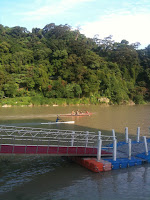
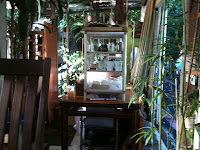
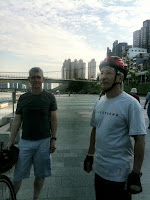
There are a couple more things to relate before I finish with my blogs on Taiwan. On the third day in Taipei, Michael, Kirk, and I went on a long bike ride, about 6 miles one way. There is a continuous green trail over 100 Kilometers (or 62+ miles) along the Danshui river in Taipei.  We started out at 5:30 a.m. when the weather was still relatively cool and arrived at a place called Bitan a little over an hour later.  Along the way we passed numerous people, young and old, walking, jogging, or biking on the trail.  Unlike in the U.S. where you expect the hiking or bike trails to be in the wilderness, this trail is located right along the highway, with the river on one side and housing developments above the river bank on the other.  Though noisy at times, one never feels isolated; it is easily accessible for people living alongside the trail.  We saw school children from a nearby elementary school running on the trail with their PE teacher, old people practicing Tai-chi, and housewives doing gentle aerobic exercises in the parks by the trail.  Michael told us that Taiwan is a haven for retirees; there is a forced-retirement age at 65 and a functioning universal health care system for every citizen.  We ate breakfast (cold soybean milk and crepes with different fillings) at a quaint, little shack, or more like a makeshift shelter, on the hill above the lake at Bitan.  On the way back, Kirk's bike got a flat tire and we had to walk the bikes for about 30 minutes to a nearby town to see about having it patched.  Unfortunately, the bike shop we found did not open until after 10, and as a result, I took a taxi home with the broken bike while Michael and Kirk rode home by themselves.  Apparently I missed the fun they had of zipping through, what Kirk described as, waves of morning traffic, among cars, motorcycles, and bicycles. 

The upshot of all this is to tell you that I've got a tough brother!  He was diagnosed with bladder cancer a little over a year ago.  He went through an operation which lasted 10 hours to completely remove his bladder and had a new one reconstructed just last March. Afterwards came chemotherapy and a grueling process of learning to use his new bladder. Due to complications resulting from the scar tissues from the operation, his kidneys still are not able to function normally and he has to wear external bags along his legs. Apparently, the distance we rode that day was one of the shortest that he, his wife, and a bunch of friends have undertaken.  How he manages to build up his muscle strength in such short time and ride long-distance carrying external bags on his legs is beyond me.  He is scheduled to be back in the operating room to have the scar tissues removed in early August and we hope that it would completely free him to live as actively as he wishes.

Here's looking at you, big Brother!

LaLa Taipei & Taiwanese female entrepreneurship

Lala Taipei
I would like to give a shout-out to Lala Taipei, the place we stayed at in Taipei.  It is a cross between a hostel and a B & B, or as they call it, a "Bed and Water".  Conveniently located, about $25 a night, clean beds, clean showers, common sitting and dining room, well-stocked kitchen, laundry facility, free wi-fi and loaner bicycles, in a safe, residential area, etc., all the essential amenities a traveler needs in a foreign place.   But the most interesting aspect about Lala Taipei is the fact that it is an enterprise started in late 2009 by a group female friends (which includes my sister-in-law) who pooled money together to buy a flat, remodel and furnish it, and operate it as a guest house/hostel.  They have since duplicated their business model to include a location in Flushing, New York, as well as Los Angeles, and Ginza, Japan.  They have also expanded their operation and invested in a cafe and a bookstore.  Quite a formidable group of women!  Taiwan has made great strides since I left 30 years ago. Kirk and I were both struck by the signs of vibrancy on the faces and in the gaits of people on the streets, of self-sufficiency and confidence, and the live-and-let-live attitude toward the ad hoc enterprise of making or eking out a living.  I'm not sure if I don't harbor a sense of longing for the place I left, but there is no going back to one's childhood.


Thriving
Green wall
I noticed while walking around Taipei these curious, clever installations affixed to the fences of all kinds of construction projects going on in the city.  Instead of the "pardon our dust" signs we see in construction sites here, which is nothing but a pure formality, the construction companies in Taiwan actually install live, breathing plants on their construction fences, creating a kind of green wall all around the perimeters of ugly construction sites.  They not only beautify the cityscape but also help purify the air and reduce pollution!  As the construction of tall city buildings normally takes months, if not years, these green walls provide a great service to improve the quality of life for people living in the city.  Now seems like a good time to segway into another point of difference between most U.S.metropolises and those in Taiwan.   Here people come to town to work and leave for home in the suburbs after work.  In Taiwan, the places for home and work are not so sharply segregated.  Most buildings usually consist of store fronts on the ground floor and residential flats above. And commercial buildings frequently bump against apartments and shops.  A continuous covered walkway links all the buildings in a block together, though not in a uniform manner.  The convenience of this kind of living arrangement makes an enormous difference to the character of everyday life; instead of getting in a car every time one wants to do anything, one can just walk to places to shop or to get a bite to eat, something familiar for those who are lucky enough to be able to live in cities such as New York.   


Lastly, I want to share with you a video clip I took of my sister-in-law having her face "done" in a traditional Taiwanese manner.  It is a dying art; I remember sitting at my grand mother's feet watching her face done in the same manner.  We went in search of one of the few practitioners of this art form in a crowded night market.  I'm not sure how to describe it - something like a person using threads winding around her fingers with one end bit in her teeth to pluck the unwanted hair on a woman's face.  It is also supposed to clean the pores and soften the skin.  I expect it's rather painful.  Carolina was actually in tears but the experience was worth it, according to her. In this video, you can also get a feel for how lively the night scene is in Taipei.