Tuesday, February 21, 2012

Adventures in the Windy City

We returned home, unscathed, from our trip to Chicago, though it was not without some anxious moments.  For your reading entertainment let me now recount some of them.  Our four-hour drive up to Chicago was a bit nerve-wracking since we didn't leave Bloomington until after 7:00 p.m. and it rained almost the entire way there.  Furthermore, neither of us had ever driven there before.  However, thanks to our competent GPS assistant in the car we arrived at our destination without any incident and were pleasantly surprised to find that we'd gained an hour after we crossed the Illinois State line.  


Though it was rather late when we got there, the Palmer House was still abuzz with people and activities.  Kirk upgraded our reservation to the Executive Level (the top two stories) of the hotel, thinking that would be a nice treat for our stay.  We were sorely disappointed, however, when we were bundled into a tiny room, not much bigger than what one gets at a roadside motel, and smelling of insecticide.  I complained to the registration clerk about the crappy room when he phoned to see if we got to our room alright and before I thought of threatening to tweet my irate review of the hotel on Yelp, he offered to move us to a different room when he came in to work the following day.


I learned from our friend K the day before we left for the trip that some of the public transportation I planned to take might be "somewhat dicey" and suggested I take some alternative routes.  After further research, I finally realized that there are several different public transportation systems in Chicago - CTA bus, CTA rail (also called "L"), Metra communter rail (run by eight independent railroad companies), and Pace suburban bus services.  I was quite overwhelmed by all these different names; I initially thought that they were just different terms referring to the same thing but I soon learned otherwise -- all were not created equal.  


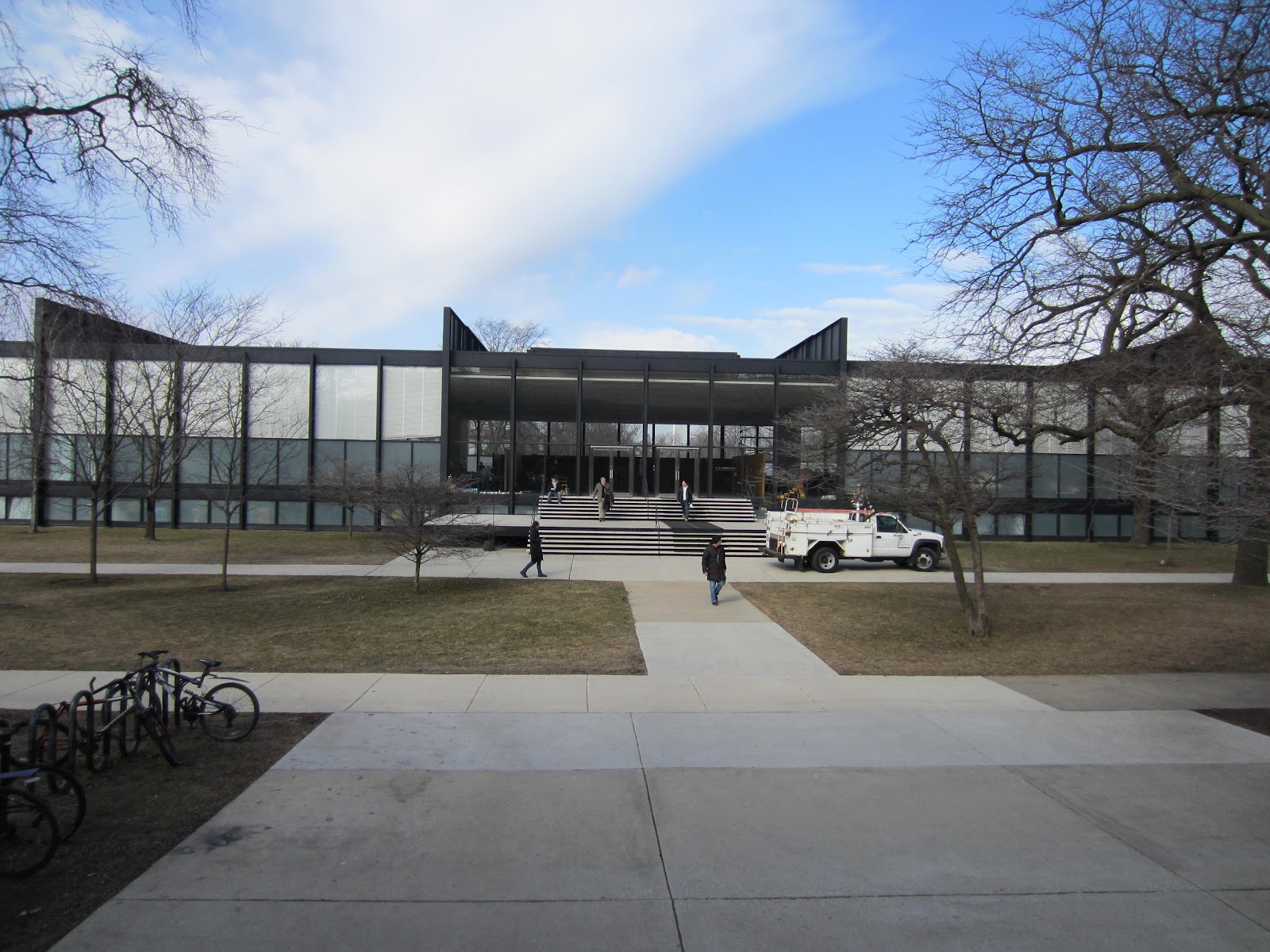
The L system, radiating from the downtown Chicago Loop, would be, I thought, the most tourist-friendly and convenient for getting about town.  Its west-bound green line takes one directly to Oak Park, the Mecca of early Frank Lloyd Wright houses, and the south-bound line takes one through the Illinois Institute of Technology (IIT) Campus, conceived, it almost seems, single-handedly by Mies van der Rohe, and then to Hyde Park, where the University of Chicago and Wright's Robie House are located.  As I had planned to visit both Oak Park and Robie House on the same day, the L train seemed to me the most logical mode of transportation to take, especially since the Metra line to Hyde Park only runs once an hour.  When I was leaving the Unity Temple, the docent there told me that the quickest way for me to get to Robie House in time to make the last tour at 3 p.m. was to take the green line back, get off at Garfield station, and hop on a cab there or take a bus. Even though Robie House is just a few blocks from the station after crossing the Washington Park, she advised me not to walk across the park by myself.  Not heeding my friend's advice to change to the Metra line downtown, I resolutely got on the green line at Oak Park and rode for about 30 minutes all the way down to the south side of Chicago.  


When I got off at Garfield station, I asked the lone station agent where the bus stop was to the University and was told that it was just on the opposite side of the station across the Garfield Blvd.  I proceeded to march across the wide boulevard with my head held high, but had to scurry right back when I got to the middle of the road after getting a 
glimpse of the bus stop area ahead.  I went back to the agent and asked him where I could get a cab.  He said, "cabs don't stop here; you'll have to call one."  I asked him for a phone number to call a cab.  I called and was told to stand in front of the station and flag one down when I saw one driving by.  I stood there for about 20 minutes and no cab came by. What with my fedora hat and fur-trimmed down coat, I stuck out like a sore thumb in front of the station.  I went inside the station and called the unified cab service number again and when I told the representative that I'd been waiting in front of the station for 20 minutes without seeing a cab, she remonstrated me by saying that "get this clear, you did not reserve a cab earlier; to reserve a cab you'll need a street number for a residence or a business."  So I asked the station agent for the street number of the station and called again.  This time I was told that train stations were not "business" and that I should walk around and find one legitimate business address and call back. There was a gas station a block away and I walked over and asked the owner of the gas station for their street address.  I then phoned again and this time made a proper reservation for a cab.  I stood outside the lively gas station in the chilly wind, where loud screams and curses from two females yelling at each other in two different cars could be heard, for another 30 minutes--and still no cab came by.  In the meantime I called that number two more times and was repeatedly told that they were still working on it.  Finally, after about 10 minutes past 3 and too late for the last tour of Robie House, I conceded defeat, gave up the whole enterprise and walked back to the station and took the train back downtown!  I was more angry than scared at the whole episode and had half a mind to write to Rahm Emanuel and ask him whether he had ever taken the green line personally in his beloved city. 


One consolation that day was that I got our room changed from a 150 s.f. "closet" space to a palatial 550 s.f. room.  We also found out that there were several privileges which come with the Execute Levels--free breakfast and afternoon h'orderves, and Executive Express elevators which skip the floors on which the hoi polloi sleep.


But, you would be mistaken to think that I didn't like the Windy City.  In fact, in the end, I did get to see and admire some very impressive architecture there, which, after all, was my main objective in visiting.  Here are some of the highlights -


Unity Temple
Skylights, Unity Temple
Frank Llyod Wright, true to his billing as "the greatest American Architect of all time," never ceases, it seems to me, to surprise and delight one as one comes into contact with any of his buildings and sees the thought that went into every little detail in them.  


Crown Hall, IIT
Carr Memorial Chapel
     
McCormick Tribune Campus Center
The Tube

State Street Village, IIT 
Train seen behind the glass screen
The campus of IIT houses probably the largest collection (18 in all) of Mies' buildings in one place.  Built in mid 20th Century, each building, made of steel and glass, with their structural elements clearly spelled out in the open, adheres unerringly to the severely rational style of Mies van der Roe.  Mies's vision and IIT seem to have been entwined together forever--witness his large portrait etched in the glass doors to the McCormick Campus Center (MTCC).  If you're not a fan of Mies, the rigidity of his style may feel a bit oppressive.  For me, they express of man's search for order and rationality. 


In recent years the IIT campus has gradually been infused with some breath of architectural freshness and diversity with the addition of several "outlandish" new buildings, most notably the MTCC and the Tube encircling the elevated L Rail, designed by Rem Koolhaas, and the State Street Village, a string of student residential blocks, designed by Helmut Jahn, alongside the railroad track, with open courtyards separated from the noise and vibration of the train track by enormous transparent glass screens.  Both of these buildings seem to be the result of a concerted effort of the University and the architects to reach out to the neighborhood surrounding it by creating the most amorphous screen possible separating the two.  While I can appreciate their admirable motivation, I'm not so sure that they've managed to achieve their lofty goal.  It is true that the elevated L line runs through the middle of the campus and is briefly wrapped within the sleek, orange, steel and concrete tube, and that the residential halls of the students seem, on the L, to be only at an arm's length away, so that one can almost touch their mostly transparent walls. However, the actual 35th Street Station is located several blocks from the tube and is surrounded by a dingy, deserted parking lot.  From what I could see, people leaving the station all seemed to be heading away from the campus.


the Poetry Foundation
Entry Courtyard, Poetry Foundation
The Poetry Foundation, designed by Chicago architect, John Ronan, is an elegant building which creates a serene "sanctuary" in the midst of an urban jungle without turning itself inward and completely shutting out the outside world.  It achieves this through the use of a perforated screen which wraps around the entire building and is offset from the exterior glass walls.  


the Modern Wing, Art Institute
Lobby, the Modern Wing
The recent expansion of the Art Institute of Chicago, the Modern Wing, was designed by Renzo Piano.  It has a soaring, light-filled, central lobby space and a series of exhibition spaces consisting of large expanses of white-washed walls, suitable for displaying the often super-sized, intensely colored, modern paintings and sculptures.  We had a most-satisfying little meal at Russian Tea Time--thanks in part to a Gift Certificate which RW gave me almost a year ago--after we left the Art Institute, rather dazed and tired. 


Deserted Millennium Park by day 
Coming alive at night (& Marija)
One of our most exciting finds in the city was Millennium Park at night.  The three-block long by two-block wide Millennium Park which fronts the Michigan Avenue to the west and the Art Institute to the south is eerily deserted during the day but comes alive at night, even when there is no musical performance rocking on the stage at the Frank Gehry designed Jay Pritzker Pavilion.  The night when we came upon it, there were light shows of gigantic faces at the Crown Fountain (it continues 24/7), people skating at the ice rink, and the popular Luminous Field, a video/music/dance performance, at the Cloud Gate.  I took a video of part of the performance with my iPhone held high over people's heads.


We spent the last morning of our stay in Chicago taking the self-guided Loop Walk.  It was like taking an architectural history class of American architecture in the early 20th Century. My neck was very sore after gazing up the facades of so many historical skyscrapers on the walk. 


Well, I'm about done with my adventures in Chicago, but there were still some unexpected ones awaiting us during our last day there.  We had parked our car in an off-site garage a block from the hotel and had paid in advance a hefty sum of $160+ for the parking.  When we finally settled into the car ready for the long drive back, we found, to our great dismay, that the battery was dead!  It turned out that we had left a map light inside the car on the whole time.  Luckily we were told that the garage attendant on our floor would be able to help us.  And indeed we found this admirable chap in his office where a gigantic portable battery charger stands ready at hand; this kind of emergency must have happened frequently.  After he jumped start our car, we cruised down to the gate to exit the garage, but when we inserted our parking ticket into the machine, we were greeted with the message,"no data found!"  This meant a trip back to the hotel and to have the ticket re-validated.  What a bummer!  But instead, I went into the garage office and showed them our hotel invoice indicating that the parking had already been paid.  No problem there, and we left the garage with a sigh of relief.  Our next task was to get out of Chicago without getting into any accident and then find a gas station to fill up the tank before continuing on our long haul home.  Four hours later we were safely back in Bloomington and after dropping Marija off, Kirk sprang another surprise to me by telling me that he just found that he had left the gas cover open with the gas cap in its holder since getting gas just this side of the Indiana state line; he had forgotten to put the cap back on and close the cover after filling up the car!  Ah, All's well that ends well! 


Wednesday, February 15, 2012

Chicago Bound

Valentine's Day 2012
Winking Windows
The first real snow this winter arrived in time for Valentine's Day; we awoke to a landscape covered in a thin layer of soft white snow which had fallen overnight.  The pictures above give a "false" impression of its being very cold.  We've become so adapted to cold weather that the low 30's (Fahrenheit) no longer seems to faze us.  Alas, by mid afternoon most of the snow had disappeared and I missed my opportunity to build a snow man, again!


We are driving up to Chicago this evening for Kirk's Central Division APA Conference.  This will be my first trip to the Windy City and I'm feeling some trepidation about it, which is very unlike my usual "fools rush in where angels fear to tread" attitude prior to any travel adventures.  There is so much to see, building-wise, in Chicago that I'm afraid I'll only be able to cover a tiny portion this time.  Here is my itinerary.   

Wednesday, February 1, 2012

General Confusion

Daffodils resurfaced
The plants are as confused as we are (and the deer too, I'm sure) about the season we are in by the relatively warm and unpredictable weather which we've had this winter.  Looking back on my posts from last year, I see "the Iceman Cometh" on the 1st of February, in contrast, it is a balmy 52 degrees this 1st day of February, 2012!  I noticed a week ago that our hyacinth bulbs have already poked through the ground; today I was shocked to see that the daffodils have already bloomed! Kirk is not as sanguine about the weather staying this warm and hopes that we won't have another freeze in the coming days to wipe out those tentative buds.

Saturday, January 28, 2012

Aquatic Dreams

IU SRSC Pool
I've recently started learning how to swim.  It may not seem much to you but it's a big deal for me.  Growing up I didn't have the opportunity to learn to swim properly, which was not uncommon for the 99 percenters in our part of the world at that time -- a fact which will become more apparent later on in my narrative.  I used to think that the reason I couldn't swim, a skill which comes naturally for some, was due to my poor eyesight.  I made an initial step towards learning to swim a couple of years before we left Gainesville in having a pair of prescriptive goggles made for me, but still I didn't make it to the pool after that.  In part, I think, it was because I didn't want to make a fool of myself in public.  It seems to be taken for granted in the U.S. that everybody knows how to swim, as if it were a birth right. 

When I saw that adult swimming lessons, for all skill (or non-skill) levels, were being offered at the IU gym, I leaped at the opportunity to learn.  On my first day of class, I observed that all the participants in the Adult Level I group were from the Near or Far East - most were IU undergraduate students from China or Korea, plus a guy from the Middle East, and two older Asian women, including me.  In contrast, the little kids in the Child group were mostly whites, with a couple of Asians, and no blacks.  I couldn't help wondering about the race distribution in both cases.  I would have thought that swimming is no longer so much a luxury sport nowadays in most parts of the world, especially in countries like South Korea or China.  And why the African Americans should not take to swimming, as opposed to basketball, football or track, I can not quite fathom.  Anyways, I personally have a strong incentive to master the basics of swimming this spring -- we will be in Australia for two weeks in early May and we plan to make a detour to Cairns and Port Douglas area for snorkeling trips to the Great Barrier Reef! 


Monday, January 2, 2012

Year In, Year Out

D.C. at night
I concluded the year 2011 with a visit to the Nation's capital, Washington, D.C.; it was a fitting end to a year spent in living, writing, reading, learning, travelling--in general, taking in, as much as I can, from the sounds and sights of life.  With the exception of travelling, all the other activities and experiences can be obtained free, or with little expense; as I grow older, I've become intensively aware how precious they are and how hungry I am for more. 


the Peacock Room, Freer Gallery
East Bldg., National Gallery of Arts
While Kirk was cooped up in the hotel room interviewing potential candidates for a new faculty position in the Philosophy Department at IU, I packed my four days in D.C. with visits to fifteen museums, galleries, and notable buildings.  I'd only been to D.C. once before, in October 2002, for the Marine Corps Marathon; I didn't get to visit many places then, this time I planned ahead to "do" the museums.  One can spend days just going around the different National museums, gardens, and the zoo of the Smithsonian.  The Smithsonian is, without doubt, the crown jewel of our national treasures; a truly democratic institution, it is open to all, admission free. I was most impressed by the collections at the National Gallery of Arts, and I consider the East Building of the National Gallery of Arts by I. M. Pei, the most dynamic museum space of them all. 


Rothko's on close encounter
(Image from the Phillips Collection)
We also visited some private museums, including the Phillips Collection, the Kreeger Museum, and the Newseum.  Among the modern masterpieces in the Phillips Collection are Renoir's Luncheon of the Boating Parties and four Rothko paintings housed in a small rectangular room limited to 8 people at one time.  I confess this was the first time that I palpably felt the force of Mark Rothko's signature "multiform" paintings of colored rectangles with fuzzy edges. They seem to be breathing, pulsating forms on close encounter; I was mesmerized.  


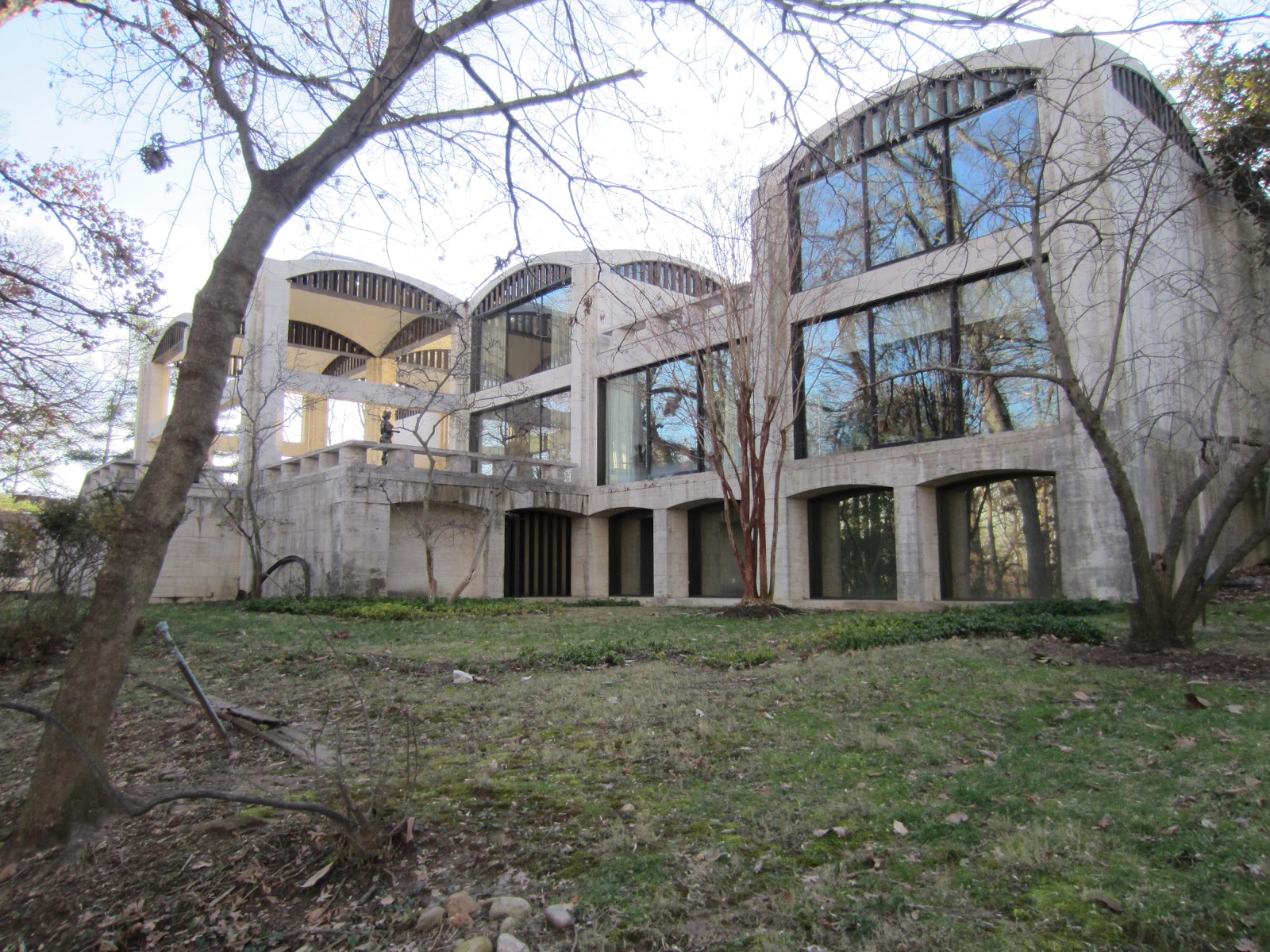
Rear Facade of Kreeger Museum
   
      Front Facade of Kreeger Museum
Art imitates Life
The Kreeger Museum, formerly the residence of the Kreeger family, designed by Philip Johnson, is a less well-known museum, at least for out-of-towners. David Kreeger, a government employee turned lawyer and art patron, who had an out-sized taste for vaulted spaces and an income to match, amassed in his life time a large collection of Impressionist and modern paintings and sculptures.  He commissioned Philip Johnson to design a 24,000 S.F. 'house' to showcase his art collections, entertain in grand style, and live in, presumably, incidentally.  As a museum, this building has found its true calling; as a place to live in, it's unimaginable--the space inside is sterile, cold, and ostentatious.  His private collections of Picasso and Monet, among others, are jaw-dropping, and from the autographed photos displayed in the cloak room, it's apparent that Mr. Kreeger and his wife enjoyed hobnobbing (and name-dropping) with the rich and famous, including almost all the Presidents and First Wives from the second half of the 20th Century onward.  We discovered a very imaginative work of art, in the now dilapidated tennis court, of twisted colored metal made to look like dead branches and vines which crept over the chain-link fence and ugly roots and vegetation strewn all over the parched surface of the tennis court.  


Newseum
Newseum, designed by Polshek Partnership Architects, is one of the few new notable recent additions (it opened in 2008) along the National Mall. This building meets its intended purpose as an interactive museum of news quite successfully, I think.  Its permanent exhibit includes historic newspapers and magazines in the originals dating back to the beginning of printed news (in book form!) from the 1400's.  Like current news media, the numerous exhibition spaces, theaters, and various interactive gadgets inside the building give one a                                                              sense of cacophony and noise. 


The U.S. Institute of Peace, designed by Moshe Safdie, is the newest public building to be erected in D.C. (it opened in early 2011).  Unfortunately, it is not yet open to the general public for visits.  I took a picture (see the photo at the beginning of this post) of its spectacular curved roofs silhouetted in the night sky from the terrace at the Kennedy Center where we went to see Billy Elliot the Musical.


Wisteria Vines in winter
Wisteria in bloom from Google
Upon leaving the Newseum, we had a deja-vu moment walking past the garden wall of the National Gallery of Arts;  Kirk recognized the wisteria vines on the wall, though severely withered, to be the original wisteria vine image I found on Google which I "photoshopped" to become the banner of my Wisteria House Design website.  It was truly a serendipitous discovery on this trip.


Wisteria House Design Banner


Wednesday, December 14, 2011

"Life Edited"

Recently I came across a video called Less Stuff, More Happiness by Graham Hill, from one of the TED talks.  Hill advocates for an edited life -- whittling the inessentials from one's life, living in smaller space with the aid of multi-functional design, reducing one's carbon footprint, etc.  He conducted a competition to design a 420 S.F. apartment in New York City to house his choice possessions.  Though one can be cynical, as many commentators were, about Hill's design desiderata -- his possessions which, though few, are an array of embarrassment of riches, I'm intrigued by the idea of editing one's life.  The verb, edit, brings to mind the arduous process of refining a piece of writing by repeatedly paring down the superfluous material until it expresses the author's intention in the most succinct fashion possible, if one considers succinctness and brevity a virtue.  As who you are is partly expressed by the stuff you own, it stands to reason that one needs to be selective and mindful about acquiring and accumulating personal effects; also, by not owing a lot of stuff, one avoids encumbering those who have to sort through one's stuff after one dies, which no doubt is an unpleasant thought.


The desire to simplify one's life occurs to most people about once or twice a year -- at the end and/or beginning of the year.  Just about now, I've been thinking about rounding up clothes and things to take to Goodwill.  I remember landing in the United States some thirty years ago with two suitcases in my hands which held the totality of my belongings; now it takes a semi-trailer truck to move all my and Kirk's stuff.  I have always been attracted by the simple, self-sufficient way of life, in Thoreau's Walden.  Here is a passage from the book about the 10 ft by 15 ft (150 S.F.) cabin he built for himself.  Maybe that is not a realistic model for me, but someday I'd like to build a smallish house, no more than 1,000 S.F., and hope by then I will have whittled down my possessions to feel totally at home in it.  Graham Hill probably can get some inspiration from Christopher Alexander's pattern #78, House for One Person and Frank Lloyd Wright's designs of Usonian Houses, a beautiful example of which is the 1,340 S.F. Jacob's House. 


A commentator on Hill's talk posted a link to a video, called Stuff, of the comedian, George Carlin, talking about American's infatuation with stuff.  It's hilarious.

Tuesday, November 29, 2011

Tainan Madness

I'd like to share with you a video, which was taken by Kirk holding the camera with one hand while the other on the handle bar of a bicycle, of me riding a bicycle on the streets of Tainan on 12.30.2003.  I did not know about it the whole time he was shooting the movie behind me on his bike.  The movie has been edited several times by Greg, the guru of all things digital, with various musical accompaniments.  Here is the version 3 of Tainan Madness -